Partner-level support across the full inspection lifecycle
From pre-readiness diagnostics through active inspection support to findings remediation, we ensure your institution is prepared, responsive, and positioned for supervisory confidence.
CFO calibration. A significant SSM finding typically carries 25–80 bps of CET1 plus 6–18 months of remediation. A senior-led, 90-day readiness engagement is a fraction of either — and buys back the negotiating position before the inspector arrives.
§ Mandate figures refer to the founders’ cumulative delivery record — several ECB/NCA on-site inspections across risks and ICAAP reviews since 2020, plus parallel CRR3 implementation, stress-testing and transformation mandates. Specific client engagements are anonymised. Sitewide public-data policy: every figure on ezelman.com is either a public-source citation, an estimate with stated methodology, or a qualitative mandate outcome.
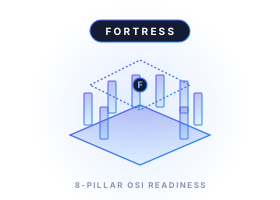
Eight defensive positions. Every ECB inspection is won or lost before the kickoff letter arrives.
Banks survive ECB on-site inspections the way fortresses survived siege warfare: not through heroism in the moment, but through terrain preparation, supply chains, and clear chains of command. FORTRESS™ operationalises that discipline — eight positions that need to be held from D-120 through the ITR response.
Proven on several ECB and NCA on-site inspections since 2020. Memorise it. Drill it. Defend it.
FOUNDATIONS
Governance, 3LoD, model inventory, data lineage — the load-bearing walls. Never rebuilt under fire.
OPEN DIALOGUE
JST relationship as a two-way channel. The inspection starts long before the notification letter.
READINESS DRILL
Mock inspection 60 days before kickoff. Stress-test evidence chains, interview discipline, data room.
TAXONOMY
Single evidence taxonomy across credit, model, data, IT. Inspectors request. You retrieve in hours, not days.
RESPONSE LINE
Daily cadence between inspection liaison, 2LoD, business, IT. One voice. Zero contradictions.
EVIDENCE VAULT
Versioned, labelled, access-controlled. Every document pre-cleared by legal, risk, and finance.
SUPERVISORY NARRATIVE
Do not argue findings. Reframe them. Own weaknesses; challenge methodology where warranted.
SUSTAIN
ITR remediation delivered on time. Capability institutionalised. Prevents recurrence of findings.
The Inspection Lifecycle
ECB on-site inspections are high-stakes events. Preparation, execution, and follow-up require meticulous planning. We manage every phase with partner-level accountability.
Pre-Inspection Readiness
Diagnostic deep-dives across governance, risk management, data quality, and model validation. Gap assessment against ECB expectations. Remediation roadmaps.
- Risk management framework review
- Model governance diagnostics
- Data quality assessment
- Documentation & evidence gathering
- Readiness simulations
On-Site Support
Active accompaniment during the inspection. Real-time interpretation of inspector requests. Coordinated response across business lines. Issue flagging and escalation management.
- Daily coordination meetings
- Inspector interaction facilitation
- Evidence production management
- Query prioritisation
- Risk issue tracking
Data Room Management
Professional data room setup, maintenance, and governance. Evidence categorisation. Document control. Inspection team coordination points and logistics.
- Data room architecture
- Evidence taxonomy & labelling
- Access control & security
- Document versioning
- Logistics & team facilities
Findings Remediation
Draft findings analysis. Remediation strategy development. Response document preparation. Supervisory dialogue management. Escalation coordination.
- Finding interpretation & impact
- Remediation planning
- Response document drafting
- Evidence supporting remediation
- Supervisory follow-up
Post-Inspection Programmes
Remediation oversight. Progress tracking against findings. Supervisory engagement. Capability building to prevent recurrence.
- Remediation roadmap management
- Status reporting & KPI tracking
- Evidence of closure
- Control design & validation
- Knowledge institutionalisation
Continuous Preparedness
Institutional readiness on an ongoing basis. Annual inspection readiness assessments. Supervisory expectations evolution. Capability updates.
- Annual readiness assessments
- Best practice implementation
- Emerging risk identification
- Framework updates
- Team capability development
Inspection Focus Areas
ECB on-site inspections span credit risk, market risk, operational risk, and governance. We bring specialist expertise in the high-stakes areas.
Credit Risk OSI
Standard Approach, IRB RWA calculation process, Loan portfolio classification, IFRS 9 provisioning, credit risk governance. Large exposure validation. Client risk rating systems. Stress testing frameworks.
IRB Model Validation
PD/LGD/EAD model inspections. Data integrity. Backtesting. Supervisory compliance. Model inventory & governance. Validation framework effectiveness.
Market Risk & FRTB
Trading book classification. VaR/SVaR validation. Risk factor hedging. Desk segmentation. P&L attribution. Model governance & independent validation.
Liquidity & ILAAP
LCR/NSFR calculation verification. Liquidity stress testing. Funding concentration. Asset encumbrance. ILAAP framework effectiveness.
Operational Risk
Operational risk governance. Data quality & loss events. RWA calculation. Business continuity & disaster recovery. Third-party risk management.
Governance & Compliance
Board oversight effectiveness. Independent governance functions. AML/CFT frameworks. Conduct & cultural assessment. Regulatory change management.
Climate Risks
ECB climate & environmental risk expectations. Climate stress testing methodology. Physical and transition risk integration into credit, market and operational risk frameworks. Scenario analysis. Disclosure under Pillar 3 ESG. Greenwashing-risk governance and risk-appetite alignment.
BCBS 239
Risk data aggregation and reporting principles. Data lineage end-to-end. Governance of data quality. IT architecture and infrastructure for risk reporting. Independent validation and remediation roadmap. Materiality, accuracy, completeness and timeliness of risk reports.
What We Bring
Our team has led several on-site inspections across European G-SIBs. We've sat in the room as both ECB inspectors and bank leadership, giving us unique perspective on what supervisors are looking for and how to best respond. We combine institutional knowledge with practical efficiency — every response is tight, evidence-backed, and aligned to ECB expectations.
What a redacted findings letter looks like when Ezelman drafts it
Below is an anonymised facsimile of the cover page and first finding from an IRB inspection response letter Ezelman drafted on behalf of a Tier-1 European bank in 2025. All identifying details (institution, JST members, portfolio, dates, amounts) have been redacted. The structure, however, is exactly as submitted and exactly as accepted by the JST at first review.
What lands on the CRO's desk — the ECB findings letter
To: Joint Supervisory Team, []
Ref: OSI--2025 · Inspection period: –
Cc: Bank’s OSI Sponsors,
Following the on-site inspection conducted between and , the Joint Supervisory Team has identified findings relating to the IRB calibration methodology, internal governance arrangements, and the integrity of the reference dataset used for PD estimation.
Named examples — institution, JST, portfolio, findings list, remediation plan — are available under NDA on first call.
Why Ezelman for Inspections
An inspection is not just a compliance event — it's an opportunity to demonstrate control maturity and supervisory engagement to the ECB. We help you position for confidence.
ECB Inspection Expertise
Led by the partner who ran a G-SIB's ECB on-site inspection response on IRB RWA — preparation, inspector interactions, and findings contestation. We know how inspectors think, what evidence they need, and what gaps trigger findings.
Active Support Model
We're physically present during inspections. Real-time coordination. On-the-fly problem solving. Escalation management. Not armchair advisory — active partnership.
Proven Track Record
Multi-year engagements with global systemically important banks. Portfolio includes successful inspections across credit risk, market risk, liquidity, and governance themes.
End-to-End Ownership
From pre-readiness diagnostics through post-inspection remediation. Seamless handover between phases. Continuous institutional support building preventative capability.