Risk & Finance Transformation
Strategic redesign of risk functions for lasting competitive advantage
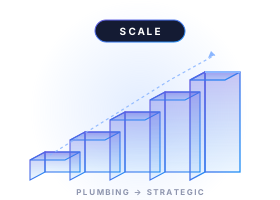
Transformation that sticks. We redesign risk and finance functions to be capital-efficient, supervisor-aligned, and positioned for long-term competitive advantage. Not just compliance plumbing — strategic redesign.
Material
Cost-to-serve reduction in target risk operating model after transformation Illustrative · directional
Compressed
Regulatory reporting cycle post-taxonomy harmonisation Illustrative · directional
Significant
FTE repositioning from reconciliation to decision support Illustrative · directional
Multi-quarter
Typical time-to-value for Ezelman-led risk transformation programmes
Flagship transformation mandate — European G-SIB CRR3 programme, over an 18–24 month horizon, with material CET1 recovery at go-live.
Partner-led, dual-track (credit + reporting), zero material supervisory follow-up.
Read the full case →
Successful transformation requires simultaneous execution across strategy, people, process, technology, and governance. We orchestrate all five.
Our Approach
Transformation fails when it's treated as a technology project or a compliance exercise. Real transformation is strategic, people-focused, and embedded in daily operations. We make that happen.
Strategic Foundation
We begin by articulating the strategic imperative. Why transform? What does success look like? How does the new operating model drive competitive advantage? Board-level alignment before execution.
Design-led Delivery
We design the future state with your team. Co-creation sessions. Rapid prototyping of solutions. Iterative validation. When you own the design, you own the implementation.
Embedded Support
Our team embeds in your organisation throughout transition. We sit next to your people. We enable. We mentor. We unblock. Knowledge transfer happens through daily interaction, not handover documents.
Supervisory Navigation
Regulatory transformation requires careful supervisory engagement. We proactively communicate change to ECB/NCAs. We flag risks. We demonstrate control continuity through transition. No surprises at inspection.
Transformation That Sticks
Too many transformation programmes deliver on time and under budget only to regress within 18 months. We build different. We focus on operational embedding, not project milestones. We measure success by capability sustainability, not go-live dates. And we stay engaged long enough to ensure the new operating model becomes the new normal.
Successful transformations deliver measurable, sustained outcomes. Here's what we target.
RWA Reduction
5-15% RWA reduction through portfolio optimisation and risk weight efficiency. Capital freed for growth. Competitive advantage maintained.
Cost Efficiency
25-40% reduction in runtime costs through technology automation and process redesign. Reinvestment in higher-value activities.
Data Quality
99%+ accuracy in critical data sets. Real-time reporting. Audit confidence. Supervisory alignment on data governance.
Faster Reporting
Regulatory reporting in days, not weeks. Real-time risk visibility. Faster business decision-making.
Capability
Stronger internal capability. Reduced external dependency. Sustained operational excellence post-transformation.
Supervisory Confidence
Enhanced dialogue with ECB/NCAs. Demonstrated control maturity. Positive supervisory feedback on transformation execution.
Transformation success requires equal parts strategic clarity and operational excellence. We bring both. And we stay long enough to ensure it sticks.
Transformation Track Record
We've led multi-year transformation programmes at global systemically important banks. From strategy through operational embedding. Portfolio includes RWA optimisation, regulatory reporting transformation, data architecture redesign.
Business Acumen
We don't live in technical silos. We understand banking strategy, capital economics, and competitive positioning. We translate business imperatives into risk design.
Supervisory Fluency
Our team speaks supervisor language. We navigate regulatory constraints. We position transformation for supervisory confidence, not just compliance. ECB relationships & respect.
Long-term Engagement Model
We're not mercenaries. We stay engaged through steady-state stabilisation. We own outcomes, not just deliverables. Your success is our success.
Two mandates, two outcomes
What SCALE™ looks like on the ground.
Both are anonymised. Both are within the last 36 months. One was a balance-sheet transformation; the other was a reporting-chain rebuild. The SCALE ladder is the same in each case; the sequence is what differs.
Case A · New-activity launch
EU G-SIB — launch of a new trading activity on gas and power.
Starting position. An EU G-SIB decided to enter a new trading activity in commodities — gas and power — with no pre-existing FO-to-BO infrastructure for the asset class, no risk-management framework for the new exposures, and no NAA/NPA committee approval at programme start.
Scope. End-to-end build of the value chain: front-office structuring desk, trading and pricing systems, market and credit risk-management framework, collateral and settlement processes, accounting treatment and finance integration, internal-control architecture, and the supervisory dialogue around the new activity. Risk & finance processes designed in parallel with the FO build.
Outcome. Activity launched with full FO-to-BO straight-through processing, an integrated risk framework approved by the NAA/NPA committee, and accounting treatment validated by the audit committee — on the original 18-month plan.
Team
6 seniors, partner-led
Case B · Asset transfer & entity wind-down
French D-SIB — transfer of bonds, loans & derivatives, with subsequent closing of entities.
Starting position. A French D-SIB carried a portfolio of bonds, loans and derivative positions in legal entities targeted for wind-down, with associated overhead and capital cost the group wanted to release.
Scope. Engineered a clean transfer of bonds and loans, novation of the derivatives book, and subsequent operational and legal closure of the entities — with cost optimisation as the explicit programme objective.
Outcome. Bonds, loans and derivatives transferred to the receiving entities; targeted entities closed on plan; sustained cost reduction recorded as the principal financial outcome.
Team
2 seniors, partner-led
Case A and Case B are real Ezelman mandates with identifying details anonymised for confidentiality. Financial outcomes are as reported by the client finance teams at programme closure; the Pillar 2 counterfactuals are the firm’s internal estimate based on peer-cohort bps at comparable thematic reviews.
Why not the Big-4 for transformation
Three things a Tier-1 consulting house cannot structurally do on a transformation programme.
The Big-4 are formidable on scale. Ezelman is built for a different problem: the regulatory-capital and supervisory-fluency dimensions of transformation, where partner-level engagement is the deliverable — not the sales pitch. Three structural differences matter.
01 · Audit-independence
We are not structurally conflicted on audit lines.
Ezelman does not hold a statutory audit practice. The transformation advice the Risk Committee receives is not constrained by a parallel firm relationship that could, on rotation, make the next audit appointment harder. See the independence statement.
02 · Senior-led by design
The partner named on the letter is the partner on the floor.
At Ezelman, no mandate is delegated to a pyramid supervised at distance. The Big-4 economic model requires leverage; ours does not. The minimum hiring seniority at Ezelman is Director, stated explicitly on the Careers page.
03 · No vendor incentive
We do not sell the tool we then implement.
Ezelman has no SaaS subscription, no platform licence, no implementation partnership that compensates us when a particular vendor wins. The transformation roadmap is the one the bank should run — not the one that maximises the adviser’s downstream fees.
Where the Big-4 do win
When scale and geographic breadth are the dominant requirement — a 40-country tax-and-regulatory programme, or a pure systems-integration mandate at hyperscale — the Big-4 operating model is built for it and Ezelman is not. We decline those mandates rather than resource them thinly.